Shower chairs: which one, and will it fit
A shower chair removes the most avoidable balance test in the house: standing on wet enamel with eyes closed and both hands busy. The product class is mature and the honest differences come down to three numbers - seat width, rated load, leg footprint - and one measurement of your own stall that almost nobody takes before ordering.
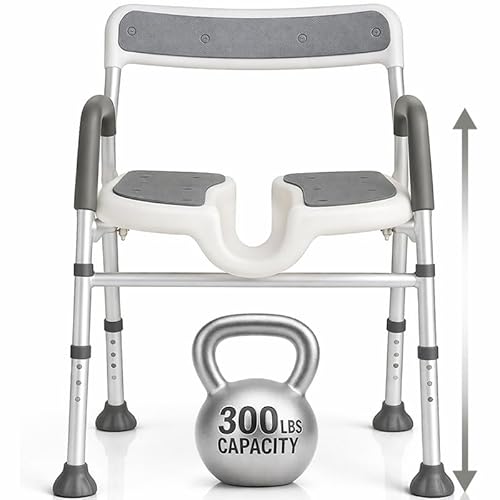
Arms give a push-off point for standing - the half of the job people forget.
Check price on Amazon (paid link)Same class of frame, plainer finish, institutional pedigree.
Check price on Amazon (paid link)Cross-braced legs, roomier seat - check your stall's flat floor first.
Check price on Amazon (paid link)The four shapes, and who each one is for
- Chair with a back and arms. The default, and the one worth buying first. The arms are not comfort: they are the push-off point that gets a person back up.
- Stool with no back. Fits a narrow stall and stores easily. It asks the user to balance unsupported the whole time, which is the thing a chair was bought to avoid.
- Folding chair on the wall. Nothing stands in the stall between uses. It is a fixing job into structure, so what is behind the tile decides whether it is possible: check the wall first.
- Sliding bench and chairs on wheels. Rolling shower chairs and sliding benches exist for transfers a plain chair cannot cover, usually wheelchair to shower. They need a level floor with no lip at the threshold, and that is a bathroom-layout question rather than a product one. We do not list one: getting it wrong puts somebody on castors on a wet slope.
If stepping over the tub rim is the hard part, none of the four solves it, because you still have to get in to reach the seat. That is the job of a transfer bench.
The numbers that decide it
| Arms | Backrest | Notes from the spec sheets | |
|---|---|---|---|
| Vive | yes | yes | Padded arms; tool-free assembly; leg height adjusts per corner |
| Medline | yes | yes | Suction-tipped feet; the plainest and the cheapest of the three |
| PELEGON | yes | yes | Cross-brace under the seat adds rigidity; widest footprint here |
Exact widths, weights and load ratings live on each listing's spec sheet - that's the number to trust, and it's one click away above.


Heavy-duty and bariatric shower chairs
"Heavy duty" on a listing is a description. The weight capacity is the figure, and it should come from the maker, with a model number you can look up. A standard shower chair and a bariatric one can look alike in a photo, so go by the rating and not by the picture.
| Maker-rated capacity | Seat | Seat height | Back | |
|---|---|---|---|---|
| NOVA Heavy Duty Bath Seat, model 9013 | 500 lb | 20 in wide, 12 in deep | 17 to 23 in | none |
| NOVA Heavy Duty Bath Seat with Back, model 9023 | 500 lb | 20 in wide, 12 in deep | 17 to 23 in | yes |
Figures from NOVA's own product pages for models 9013 and 9023, read on 1 October 2026. We have not tested either.
The 9013 is a seat with no back, so everything said above about stools applies to it: the user sits unsupported. NOVA makes the same seat with a back as the 9023, and for most people that is the one to look for. We link only the 9013, because it is the one we could match to a listing by its stated capacity and height range.
NOVA 9013 on Amazon (paid link)
Two checks specific to this kind of chair. A 20 inch seat is wide, so take the measurement in the next section before ordering. And the rating covers the chair, not the tub or shower floor under it: that limit is the tub maker's.
Will it fit your stall?
The one measurement that prevents the return
Measure the flat floor of the tub or stall - not rim to rim. Curved tub walls steal inches exactly where the chair's feet land. If the flat zone is narrower than the chair's leg footprint, no amount of leg-adjusting fixes it; that bathroom wants a transfer bench, not a chair. Sixty seconds with a tape measure against three minutes filling out a return form.
If they say they don't want one
A chair in the shower is the loudest of the bathroom changes - it's visible every day and it says something the person may not be ready to hear. Two framings that work better than safety statistics: it's for washing feet without hopping (true for everyone over forty), and it's what hotels put in nice walk-in showers anyway. If the conversation stalls entirely, start here - and lead with the invisible fixes while the chair waits its turn.
Questions people actually ask
- Do shower chairs fit inside a bathtub?
- Measure the tub's flat floor against the chair's leg footprint from the spec sheet. Curved walls steal inches at leg height. Narrower than the footprint → transfer bench, not chair.
- Arms or no arms?
- Arms if standing up is the hard part - they're the push-off point. Armless only when side transfers matter more. In doubt, arms: sitting is easy, rising is the risk.
- Why does it wobble?
- One leg is on the tub floor's curve. Set the legs one notch different side to side until all four land flat. A rocking chair teaches distrust of the one object that must feel solid.