Clamp-on tub rails: what they hold, and the tub they won’t
The tub edge is the single hardest thing in the bathroom to cross safely — a high wall to swing a leg over, wet feet, nothing rated to grab. A clamp-on rail bolts a handhold right there with no drilling, which makes it the obvious no-drill answer. The catch is the same one every no-drill device has: it’s only as strong as what it grips. Here that means the tub wall itself, and not every tub wall qualifies.
Powder-coated steel, height-adjustable, clamps to walls roughly 3–7 in thick. Manufacturer-rated to 300 lb — on a rigid wall.
Check price on Amazon (paid link)On a solid steel or enameled tub wall, a metal clamp holds predictably — a real handhold, not just a balance touch.
If the wall flexes when you press it, the clamp has nothing to bite. This is a surface problem no product fixes.
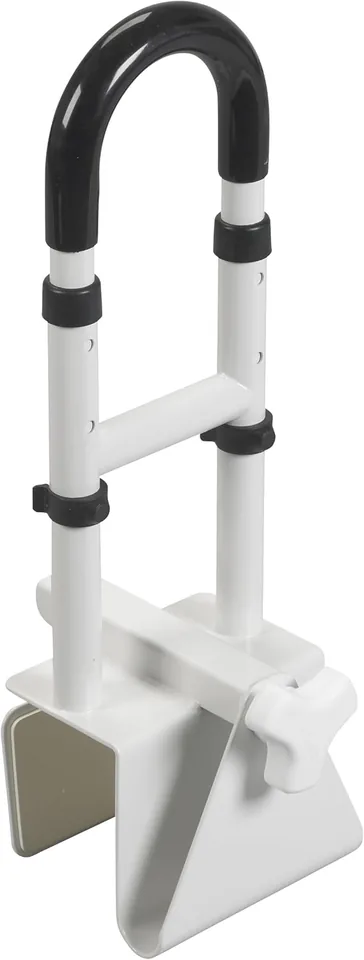
The one thing that decides if it works: your tub wall
Press the wall before you buy
Push firmly on the inside of your tub wall with the heel of your hand. A steel or thick enameled wall doesn’t move — that’s what a clamp needs. If it flexes even slightly, you have a fiberglass or thin acrylic surround, and the manufacturer says plainly this rail is not for use on fiberglass tubs. It’s the same logic as our wall-type guide for anchored bars: the mount is never stronger than the surface behind it.
What it holds — stated honestly
Drive Medical rates this rail to 300 lb, a figure that appears consistently across the brand’s own documentation and independent retailers. We report it as a manufacturer rating, not an independently certified test result — we say “rated to 300 lb,” never a bare promise that it catches a fall. That rating also assumes correct installation: clamp fully tightened, on a rigid wall, within the thickness range. How we decide what earns each label.
The numbers that decide it
| Material | Rated to | Fits wall | Adjust | |
|---|---|---|---|---|
| Drive Medical RTL12036-ADJ | powder-coated steel | 300 lb* | ~3–7 in | height 14–17 in |
*Manufacturer rating on a rigid wall; confirm the figure and thickness range on the listing for your variant. Not for fiberglass or flexing tub walls.
Clamp-on, suction, or anchored: which belongs at the tub
Three ways to put a handhold at the tub edge, in descending order of what they hold. An anchored bar into a stud is the strongest, but the tub wall rarely has a stud where you need it — that’s the permanent-bar route, worth it when the geometry allows. A clamp-on rail is the no-drill step down: strong on a rigid wall, useless on a flexing one. A suction bar is weaker again and surface-dependent — we pressure-tested why it’s a steadying aid, not a catch. Match the device to the wall you actually have, not the one you wish you had.
Questions people actually ask
- Do clamp-on tub rails hold body weight?
- On a rigid wall, yes — the Drive Medical model is manufacturer-rated to 300 lb. It’s a real handhold, but not a stud-anchored fall-arrest bar.
- Will it work on my tub?
- Only if the wall is rigid and within the clamp’s thickness range (about 3–7 in). Fiberglass and flexing acrylic tubs are explicitly out.
- Clamp-on or suction bar?
- Clamp-on holds far more predictably at the tub edge. Suction is a lighter steadying aid that depends on a smooth, clean, wet-resistant surface.
- Does it replace a grab bar?
- No. Where a real fall must be caught and a stud is reachable, an anchored bar is the stronger answer.