Tension poles: the honest no-drill grab bar
If you need support that could catch a falling adult and you cannot drill - because it's a rental, because the wall is fiberglass, because your mother said no to "hospital bars" - a floor-to-ceiling tension pole is the only class of no-drill device with a real load rating. Suction bars steady a hand. A pole braced into the structure of the house holds a person.
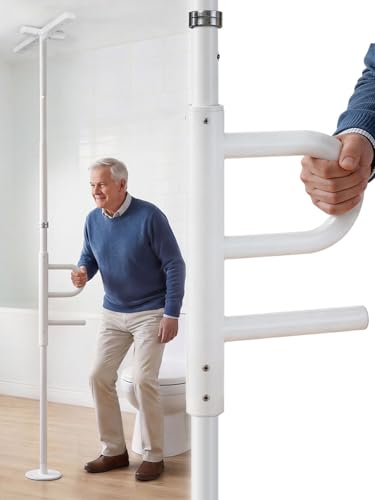
Rotating handle, matte black option, rated load published. The one we'd put in first.
Check price on Amazon (paid link)Different job, better tool - floor-standing rails don't touch the ceiling at all.
See bed railsBalance aid only, and only on smooth glaze. Full breakdown of why:
Read the failure analysisHow it actually holds
The pole is held by the house, not by the wall. A jack mechanism compresses it between the floor and the ceiling; friction and preload do the rest. Nothing is drilled, and nothing is left behind when it comes down - which is why this is the renter's answer, the fiberglass-surround answer, and the "we're not making the house look like a ward" answer, all in one device.

The numbers that decide it
| Rated load | Needs | Reversible | Renter-safe | |
|---|---|---|---|---|
| Tension pole | ~300 lb* | Solid ceiling, 7-10 ft | Yes | Yes |
| Suction grab bar | balance only | Smooth non-porous glaze | Yes | Yes |
| Clamp-on tub rail | ~250 lb* | Tub rim 3-7 in thick | Yes | Yes |
| Screwed grab bar | ~500 lb* | Stud or masonry anchor | No | Ask first |
* Always confirm the rating on the exact model's spec sheet - that's where ours come from.
Will it work in your bathroom?
The 60-second ceiling test
Stand where the pole would go and push up hard on the ceiling with a broom handle. It should not move, flex, or sound hollow. A suspended tile, a garage or basement conversion, or old soft plaster fails this test - and a pole against a failed ceiling is worse than nothing, because it looks like support.
Then measure floor to ceiling at that exact spot. Most poles span roughly 7 to 10 feet; sloped ceilings change the number away from the wall. Write the measurement down before you open the listing.
If they say they don't want one
A grab bar reads as a diagnosis. A pole reads as furniture - it stands in the room like a towel warmer or a lamp, and the matte black version doesn't pretend to be medical at all. In practice that difference is the whole conversation: you're not bolting a statement about decline onto the wall, you're standing a piece of hardware in the corner that happens to be there when a hand reaches out.
If the conversation itself is the hard part, start here instead - the hardware can wait a week; the relationship can't.
Questions people actually ask
- Can renters install a tension pole?
- Usually yes. It braces between floor and ceiling with no fasteners and leaves no holes. Check the ceiling first - drop ceilings and soft plaster won't take the load - and most landlords have no grounds to object to a device that touches nothing permanently.
- How much weight does a tension pole hold?
- Typical rated capacity is around 300 lb per the manufacturer's spec - confirm the figure on the exact model. The rating assumes a solid ceiling. Against a suspended tile, the rating is meaningless because the ceiling fails first.
- Do tension poles damage the ceiling?
- On a solid ceiling, no: the load spreads through a padded plate and the pole comes down without a trace. On a weak ceiling the plate can crack the surface - which is why the broom test comes before the purchase.
- What ceiling height do they fit?
- Most models span roughly 7 to 10 feet. Measure at the spot you'll place it, not at the wall - sloped and dropped sections change the number.
- Tension pole or suction bar - which is safer?
- Different classes of device. Suction steadies a hand on smooth glaze and is not rated to catch anyone. A pole on a solid ceiling carries a real rating. If the question is "what happens if they go down", the pole is the only no-drill answer.
- Where should it go?
- At the transfer point - where sitting becomes standing. Beside the tub step-over, next to the toilet, or by the bed. It replaces the towel bar and the doorframe people actually grab today.
What we'd buy
The Vuns 360 is the pole we'd put into a first no-drill setup: published load rating, a handle that rotates and locks, and a matte black finish that answers the "hospital look" objection out of the box.
Check price on Amazon (paid link)We don't show Amazon prices - they change hourly and stale numbers help nobody. The button opens the live listing.